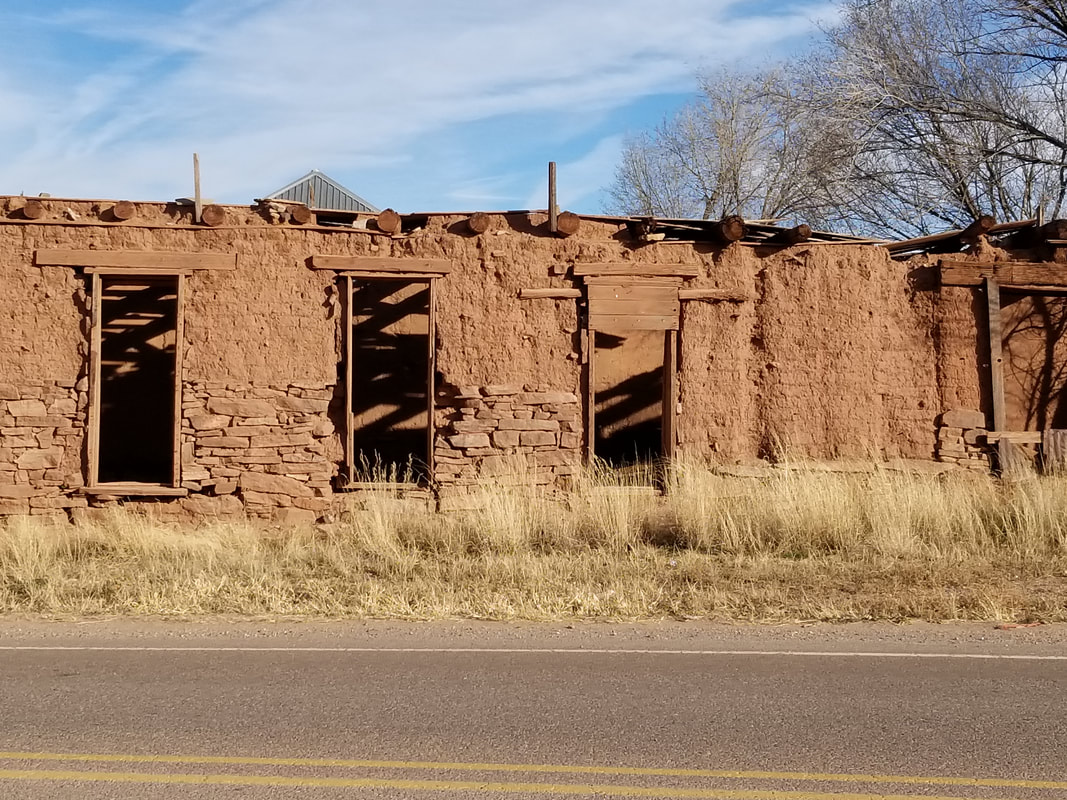
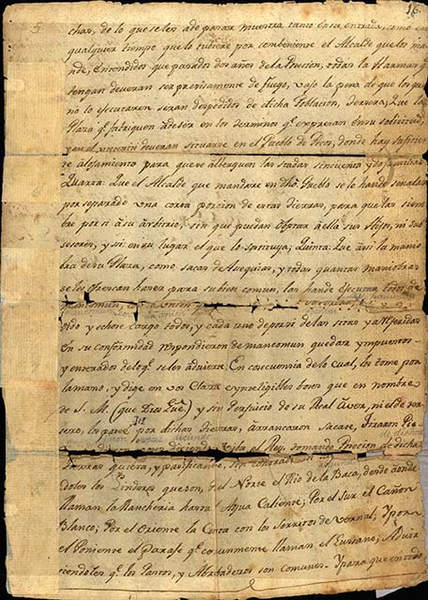
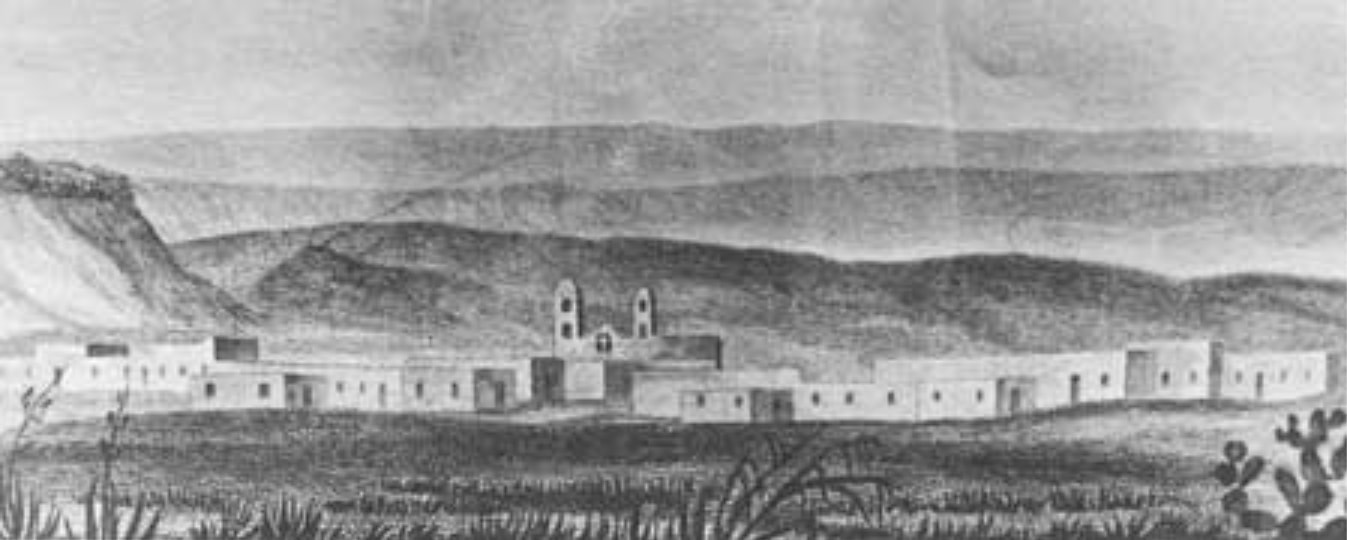
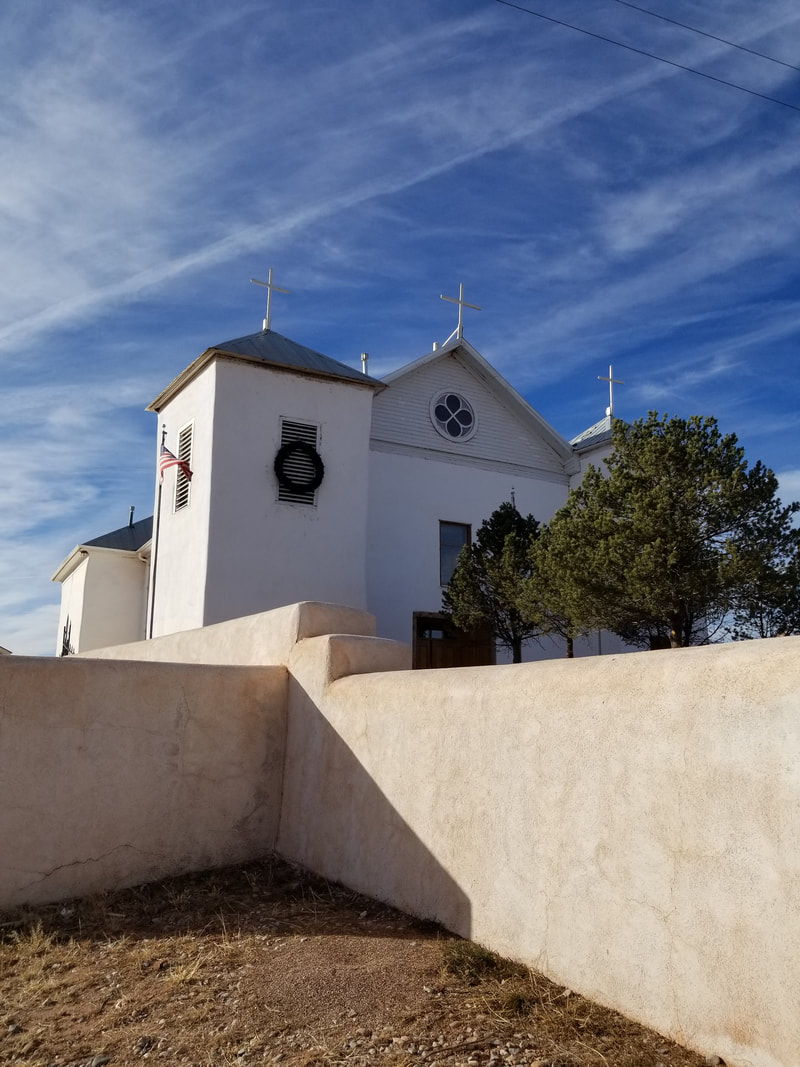
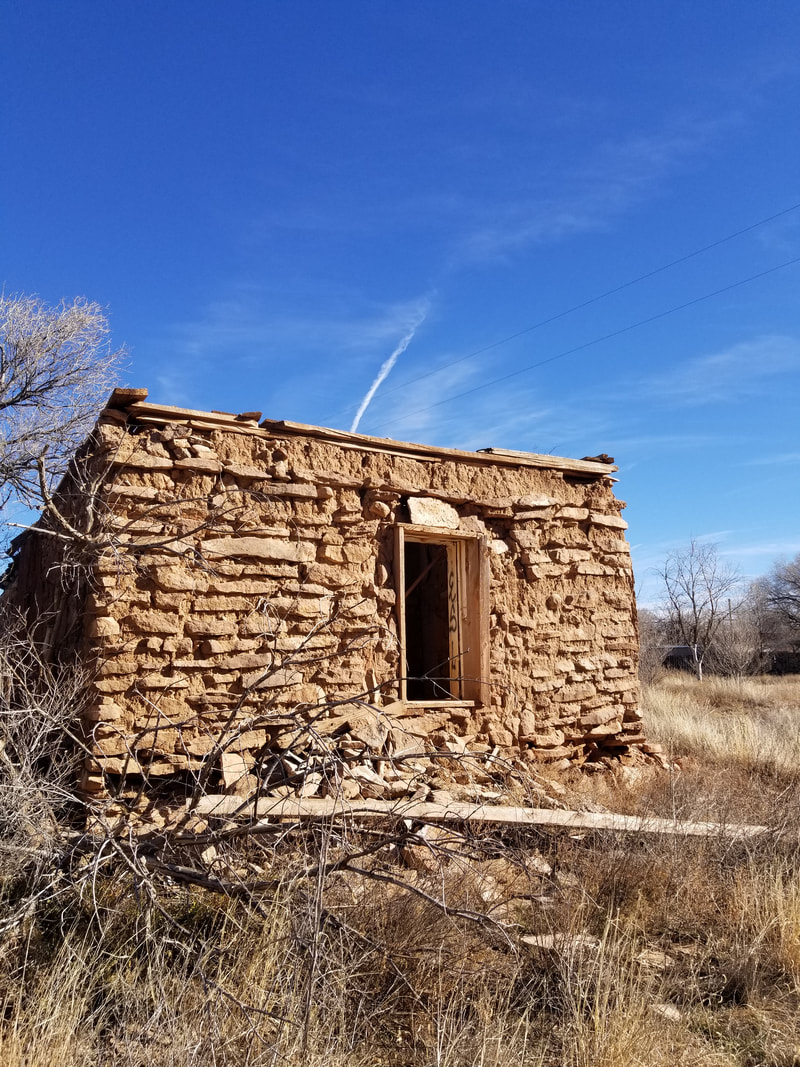
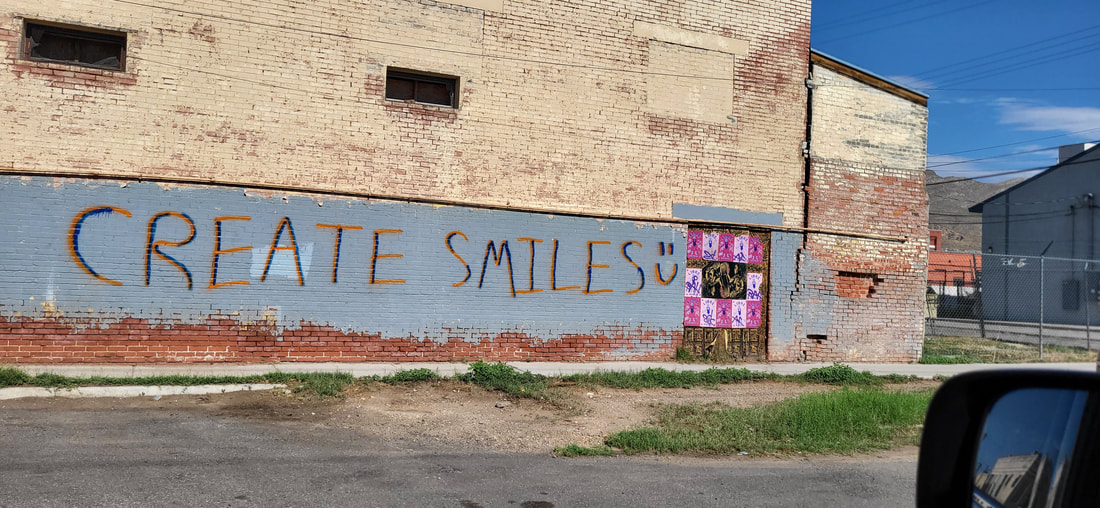
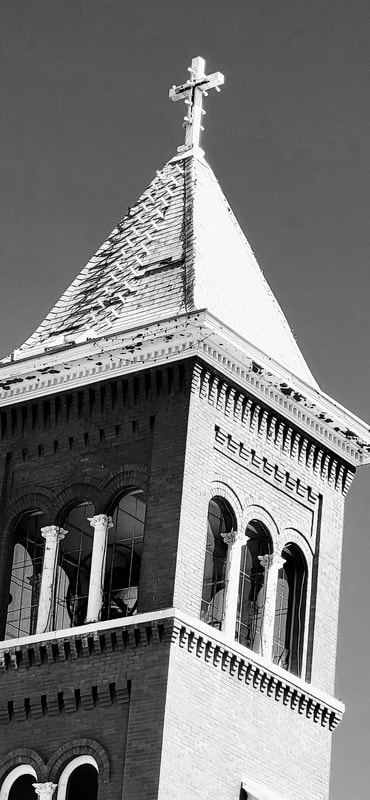
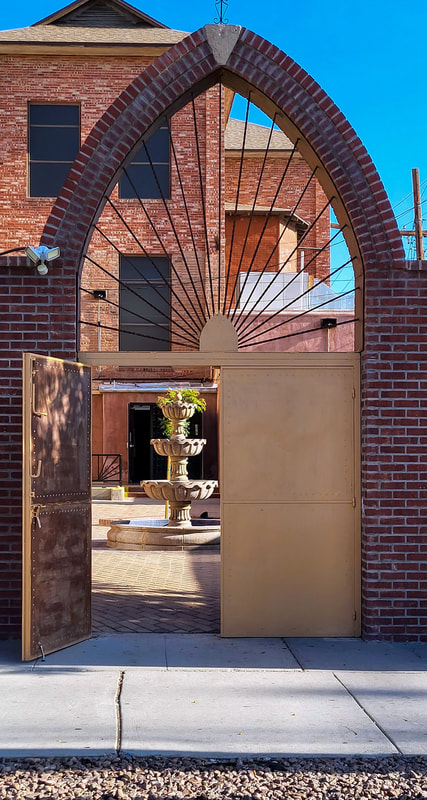
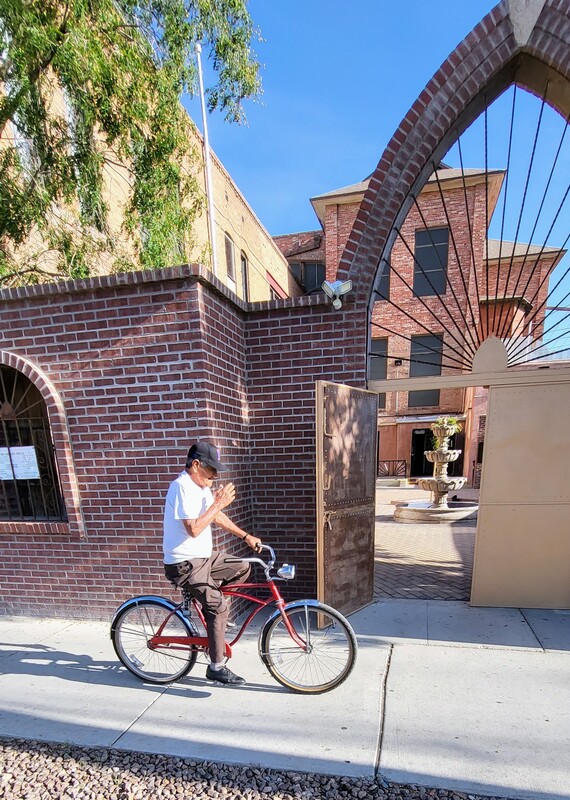
Adobe building across from San Miguel Catholic Church Winter is slow-coming to San Miguel this year. The nights and early mornings are chilly, making the warmth of the wood stove welcomed. A few days this week, the icy winds blew hard. But the mountains have no snow this year and the people of the valley are afraid of wildfires and depleted water supplies for their wells with no spring melting snow. The 900 mile long Pecos River that flows from New Mexico to Texas is already low. The mountains are filled with juniper and cedar, darker green in the winter than in the spring, and the silhouettes of gray and white leafless trees. The evergreens are stark next to the dark red soil of the valley. In the 17th century, the area was a borderlands between the encroaching Spanish empire and the Indigenous settlements that existed there for thousands of years. The settlements of this valley, San Miguel, San Jose, San Juan, Villanueva, Sena, and Ribera, are two centuries old. Some like El Barranco exist mostly on land titles and few remember their names. I wonder if the people who have lived in the valley for generations remember their history. In this part of New Mexico, it would be difficult to forget. One piece of land may hold the homes of several generations: a more modern mobile home next to an older adobe home, next to the crumbling remains of an ancient adobe house dating back 150 or 200 years. Everywhere, the disintegrating adobe homes call on us to remember the hard-working people who built them in this beautiful but isolated place. San Miguel del Vado Grant, Spanish Archives of New Mexico, Series 1. Surveyor General Records . From: http://dev.newmexicohistory.org/filedetails.php?fileID=9998. The history of this valley is a microcosm of centuries of colonization and nation-building, from Spanish settlement of the northern frontier of New Spain to the US takeover of northern Mexico in the mid-19th century. It is the story of hope for the future, loss, and resistance. When Spanish explorers first arrived to the area in the 1530s, they encountered people who they would call the Pecos, an indigenous group with roots going back millennia in the area. Puebloan culturally, they were an agricultural people who grew corn, beans, and squash and built home of adobe and rocks. Their settlements included home and kivas, underground places of great spiritual significance. Each kiva had a hole in the center representing the underworld from where the people had emerged. For unknown reasons, by around 1450 many of the Pecos settlements had been abandoned, consolidated into one. It was this ancient, thriving culture that first encountered Spaniards looking for the city of gold, Cibola. Left: San Miguel del Vado (1846) Facing toward the west, from the Report of J. W. Albert of his Examination of New Mexico in the Years 1846-1847 Right: San Miguel Catholic Church (2017) In 1794, the governor of Nuevo Mexico approved a petition by Lorenzo Marquez and 51 others living in Santa Fe who asked for land in order to provide for their families. Santa Fe, they said, had scarce water. According to the petitioner, 13 of the 52 families were Indian, probably Pecos, and historian Malcolm Elbright argues that the majority of the families were genízaros or mestizos. Genízaros were Indigenous people, often captives, who were enslaved or employed as servants. Some were given land, as in the case of San Miguel. Some retained connections with their people; others were completely cut off. They were an important part of the settlement of San Miguel and the surrounding communities. The San Miguel del Bado land grant was the first significant communal land grant in the northern borderlands of New Mexico. (Bado or vado refers to a place where the river can be forged. The two spellings are used interchangeably although Bado is the more common.) When land was finally distributed in 1803, the governor required that each household possess arms and ammunition within two years. The petitioners offered to build a well-fortified plaza for their protection. Attacks by Apaches and Comanches were foremost in their minds. For the original settlers, access to land was key to the survival of their families. The communal nature of the land grant meant that everyone would share grazing and agricultural land. For the Spanish government, a communal land grant would act as a buffer between the Comanches and Apaches and the Villa de Santa Fe. Old adobe building, Village of San Juan In 1846, fifty years after the settlers from Santa Fe first arrived in San Miguel, the US military under General Stephen Kearny entered the area. The United States had declared war on Mexico, long desiring possession of its California ports, and Kearney led his men down the Santa Fe Trail to establish a US provisional government in New Mexico. In Tecolote, San Miguel, and San Jose, Kearny climbed on the roofs of buildings, gave a stern warning to the people that they must swear loyalty to the United States or face death. Kearny promised that the US would protect their life, property, and religion. In San Miguel, the priest and the mayor objected, saying that they would not commit the sin of renouncing loyalty to their nation, Mexico. When the United States won the US-Mexico War and signed the 1848 Treaty of Guadalupe Hidalgo, the San Miguel del Vado grant became part of the US. Kearny's promises of protection would not hold. As Malcolm Ebright writes, "The story of the settlement of the communities within the San Miguel del Bado grant contains the seeds of a tragic loss, the loss of all the common lands." Over the course of three decades, the American government was able to reduce the size of the San Miguel del Bado Land Grand from 315,300 to 5,000 acres. A US Supreme Court ruling in the United States v Sandoval (1897) ruled that the communal lands passed from the Spanish government to the Mexican to the US governments. This ruling was in opposition to Spanish and Mexican law that said communal lands were owned by the community and not the government. When a special commissioner was appointed by the federal government to assess the boundaries of the San Miguel grant, he found 5,000 residents living there on a little more than 3,500 acres divided into ten tracts. In the 1960s, the Trustees of the San Miguel del Bado land grant transferred land to create the Villanueva State Park. Following the Sandoval case, no communal land grant was ever confirmed again, leading to the loss of perhaps millions of acres of land belonging to Spanish Mexican families in the Southwest. For a great article by Malcolm Ebright, see "San Miguel del Bado Grant" at http://newmexicohistory.org/places/san-miguel-del-bado-grant.
6 Comments
Carol
8/17/2018 02:11:56 pm
The building across from the Church in San Miguel, once was the home to my great grandparents Aparicio and Emilia Tapia.
Reply
Benjamin Marquez
2/20/2020 12:40:27 pm
Lorenzo Marquez is my 5th great grandfather.
Reply
Nancy Zamora
3/30/2021 08:49:05 am
My family on paternal and maternal sides all came from San Miguel del Bado dating from 1700’s and maybe before. I was able to trace my ancestors back to my 7th and 8th great-grandfather to that area.
Reply
John Hein
4/22/2021 09:42:25 pm
My Great-Grandfathers: Jose Maria de la Merced Baca and Benito Crespin were two of the families that owned land in the area. I have spent some time looking through the US Census and and the New Mexico census of 1880 hoping to gain insight and knowledge about their livelihood there. While I had always considered myself a Baca/Crespin it wasn't until I reconciled the roster of the Oñate Expedition with the names in San Miguel and the names of my family tree that I need only go back a few generations to find that I am also a Gallegos, a Bernal, a Zamora, a Griego, a Padilla, a Lucero de Godoy and it seems. dozens of other names. Years ago, when I was a young boy, I was sitting on a bus bench in Los Angeles, with my Mother and her older sister. A man was walking towards us. My Aunt remarked, "He looks like a New Mexican:. My Mother looked over and said, " He walks like one too". I've carried that memory with me for 70 years, smiling to myself when it arises, as I think, "Boy!. Those two sure could be silly form time-to-time.". I realize now that they were serious. Perhaps his face, hair, and yes, perhaps even the manner in which he walked, evoked a memory of a relative, or a neighbor. He looked like family.
Reply
Shannon McCoy-Hayes
9/5/2021 12:28:30 pm
This is so interesting. The history is both powerful and illustrative re: US treatment of landholders during the transition between territorialism and statehood. There were land grabs all over the state, weren't there?
Reply
Becky Elise
11/6/2024 10:40:34 am
I promised Great Odunga to always post his testimony and I really want to say "Thank You" to everyone who supported me through the years. My name is Manuel Franco, New Berlin, Wisconsin. My story of how I won the Powerball lottery of $768.4M is a bit of a tale. I was feeling very lucky that day because I had contacted Great Odunga to help me with the winning Powerball numbers. I really had that great great feeling that I looked at the camera wanting to wink at it. I only did a tiny part of it when he told me he would give me the numbers and trusted him. He gave me the numbers after I played a couple other tickets along with it for $10. I checked my ticket after the winnings came online and saw the numbers were correct including the Power play. I screamed for about 10 minutes because it felt like a dream coming into reality. I had won $768.4M. Thank you Great Odunga. Well, his email is [email protected] and [email protected] You can also call or Whats-app him at +2348167159012 so you guys can contact him
Reply
Leave a Reply. |